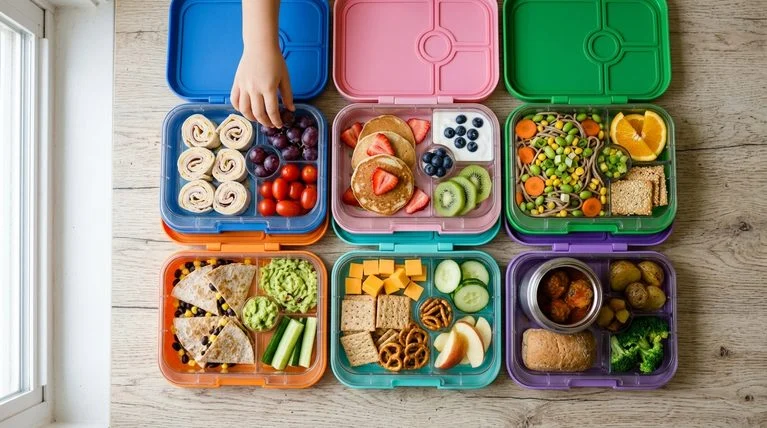
60 Kids Lunch Ideas by Age & Prep Time
Finding kids lunch ideas by age is more useful than relying on one giant list, because a lunch that works for a toddler at daycare may come home untouched from an elementary or middle-school cafeteria.
This guide organizes 60 kids lunch ideas by age, covering toddlers and daycare, preschool, elementary school, and middle school and up. Within the younger age groups, ideas are also sorted by prep time — no-cook, about 10 minutes, or made ahead — so you can choose something that fits both your child and your morning.
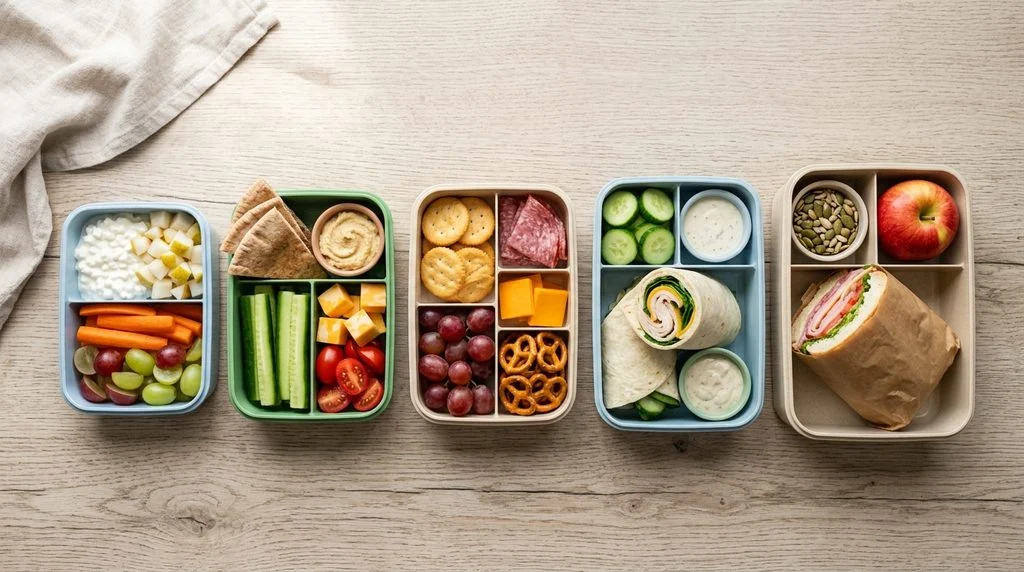
And before any of it, the part most lunch articles skip: why the food you packed came home uneaten.
Why Lunches Come Home Uneaten
Before trying more kids lunch ideas by age, it helps to work out why the last lunch was not eaten. The problem is often timing, packaging, temperature, or portion size rather than the food itself.
Before adding more ideas, it’s worth working out what went wrong with the last one. In practice it’s almost always one of seven things, and only one of them is about the food itself.
They ran out of time. A school lunch period is often twenty to thirty minutes, and a chunk of that goes to queueing, washing hands and sitting down. Actual eating time can be closer to ten or fifteen minutes. Younger children also spend some of it talking. Anything that needs assembling, unwrapping in stages or careful spooning is competing against that clock and losing.
They couldn’t open it. This is the big one for preschool and kindergarten. A yogurt tub with a foil lid, a clamshell that needs two thumbs, a zip bag sealed too well, a thermos tightened by an adult — all of it comes home full. Test every container with your child at the kitchen table before it goes in the bag, and let them open it themselves. If they can’t, it isn’t a lunch.
It was the wrong temperature by the time they got to it. Warm yogurt, sweating cheese, a wrap that has gone soft and heavy. Kids are much less forgiving about this than adults.
It went soggy, brown or leaked. Dressing on the salad at 7am is dressing-soup at noon. Cut apple with nothing on it browns. Tomato in a sandwich wets the bread. Every one of these has a fix and they’re in the sections below.
There was too much of it. A lunchbox that looks generous to an adult can read as a task to a small child. Packing less, in smaller pieces, very often gets more eaten. If two thirds comes home every day, pack half as much and add a second snack instead.
It was unfamiliar, in front of an audience. A food a child eats happily at home can be refused at a lunch table because it looks different from what everyone else has, or smells strong, or needs explaining. This peaks around ages six to eleven. It isn’t fussiness so much as social self-protection, and it passes.
They filled up before lunch. If morning snack is a granola bar and a juice box at half past ten, lunch at noon was never going to happen. Worth checking with the teacher before rewriting the entire menu.
None of that requires a new recipe. Most of it requires a different container, smaller portions, or moving the dressing into a separate pot.
The Four-Slot Lunch Build
A simple way to use kids lunch ideas by age is to keep the same four-part structure while changing texture, portion size, and complexity as children get older.
- Ages 1–3: softer textures, smaller pieces, easy-to-grasp foods.
- Ages 3–5: simple finger foods, dips, and containers they can open alone.
- Ages 5–11: sturdier wraps, pasta boxes, snack plates, and familiar hot lunches.
- Ages 11+: larger portions, more filling mains, leftovers, and self-packed lunches.
This framework makes kids lunch ideas by age easier to adapt without starting from a new recipe every morning.
Once this is in your head you can stop reading lists, including this one.
Slot one, the anchor. The substantial thing: eggs, chicken, beans, cheese, tuna, tofu, lentils, yogurt, a sandwich filling. This is what keeps them going through the afternoon. It’s also the slot most likely to get skipped when you’re in a hurry, which is exactly why it goes first.
Slot two, the carb they’ll actually eat. Bread, rice, pasta, crackers, tortilla, pita, potato, oats. Note the wording. The wholegrain version they refuse is worth less than the white version they finish.
Slot three, produce cut the way they like it. Not the way it’s meant to be served. Grated instead of sliced, peeled instead of skin-on, separate instead of mixed in. The cut matters more than the vegetable.
Slot four, something that reads as a treat. A couple of squares of chocolate, a few pretzels, a cookie, some yogurt-covered raisins. This is not a failure of nutrition, it’s the reason the rest of the box gets opened. A lunch with nothing to look forward to gets traded or ignored.
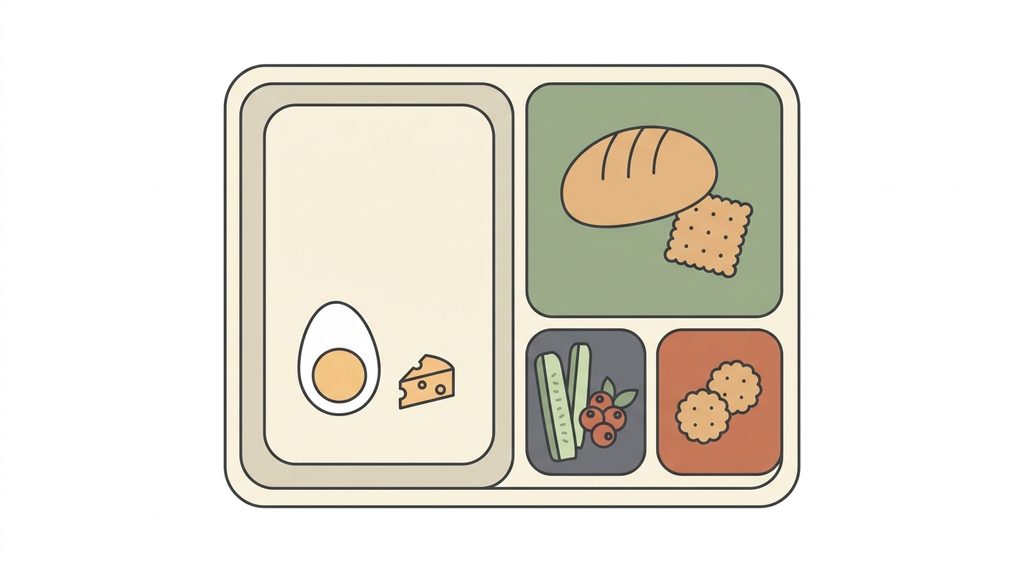
Then two things that sit across all four slots: it needs to be the right temperature at noon, and they need to be able to open every single item without help.
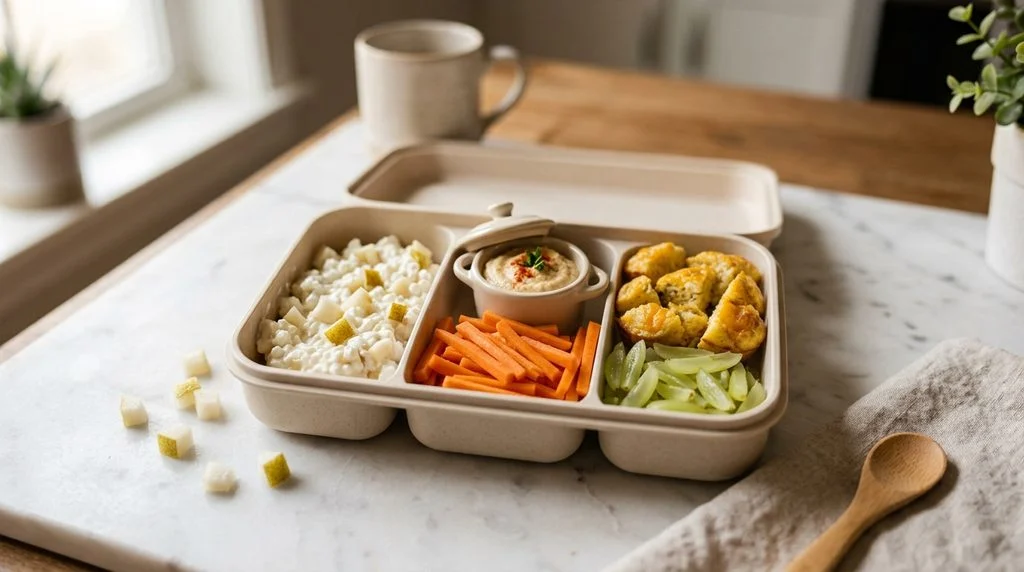
Kids Lunch Ideas by Age: Toddlers & Daycare (1–3)
For toddlers, kids lunch ideas by age need extra attention to softness, choking risk, daycare rules, and foods that are easy to pick up and eat independently.
Different rules here, and they matter more than the ideas. Pieces need to be small and soft. Many daycares have their own list of what they will and won’t accept, sometimes down to how food must be cut, and some will simply send food back. Ask for the policy in writing rather than guessing.
Sizes and choking risk get their own section further down. Read that before packing for this age group.
No cook, five minutes
For busy mornings, these kids lunch ideas by age keep preparation simple while still matching the needs of the age group.
1. Cottage cheese with soft ripe pear. Full-fat cottage cheese, a very ripe pear in small dice, and a spoonful of cooked small pasta stirred through to make it less wet. Comes together in the time it takes to find the lid.
2. Yogurt with smashed berries and oats. Plain whole-milk yogurt, raspberries crushed with a fork, a tablespoon of quick oats stirred in the night before so they soften. Sweet enough without adding anything.
3. Cream cheese and cucumber coins. Soft tortilla, thin layer of cream cheese, grated cucumber squeezed dry in a tea towel first so it doesn’t turn the wrap to mush. Roll tight, chill, cut into thin coins.
4. Soft dippers with hummus. Carrot and broccoli steamed until a piece squashes easily between your fingers, plus hummus. The steaming is the point — raw carrot is not for this age.
5. Banana and seed butter rounds. Flatten a slice of bread with a rolling pin, spread thinly with sunflower seed butter, lay half a banana along one edge, roll and slice into rounds. Thin spread, not thick — a thick layer of any nut or seed butter is a choking risk.
Ten minutes, one pan
These kids lunch ideas by age need a little cooking but are still realistic for a weekday routine.
6. Egg and cheese bites. Whisk eggs with grated cheddar and a splash of milk, bake in a mini muffin tin at 180°C/350°F for about 12 minutes. Cool, quarter. Keeps three days and freezes.
7. Tiny pasta with pesto and peas. Orzo or ditalini, a mild pesto loosened with a spoon of the pasta water and some olive oil, frozen peas stirred in while everything’s hot. Serve cold.
8. Quesadilla strips. Cheese quesadilla, cooled completely, then cut into thin strips rather than wedges — easier for a small fist and no long stringy pull.
Made ahead
Make-ahead kids lunch ideas by age are useful when you prefer to shift the work to evenings or weekends.
9. Chicken and sweet potato cups. Shredded cooked chicken folded into mashed sweet potato, portioned into small pots. Freezes well, defrosts overnight in the fridge.
10. Soft lentil patties. Red lentils cooked soft, mashed with grated carrot, a little flour and egg, fried gently as small thin patties. Cook a batch, freeze in layers with paper between.
Kids Lunch Ideas by Age: Preschool (3–5)
Preschool kids lunch ideas by age work best when food is familiar, easy to open, and simple to dip, hold, or assemble.
This is peak can’t-open-it territory, and peak dipping. Almost anything gets eaten if there’s something to dip it in. It’s also the age where a food they loved last month becomes unacceptable this month, which is normal and not worth fighting.
No cook, five minutes
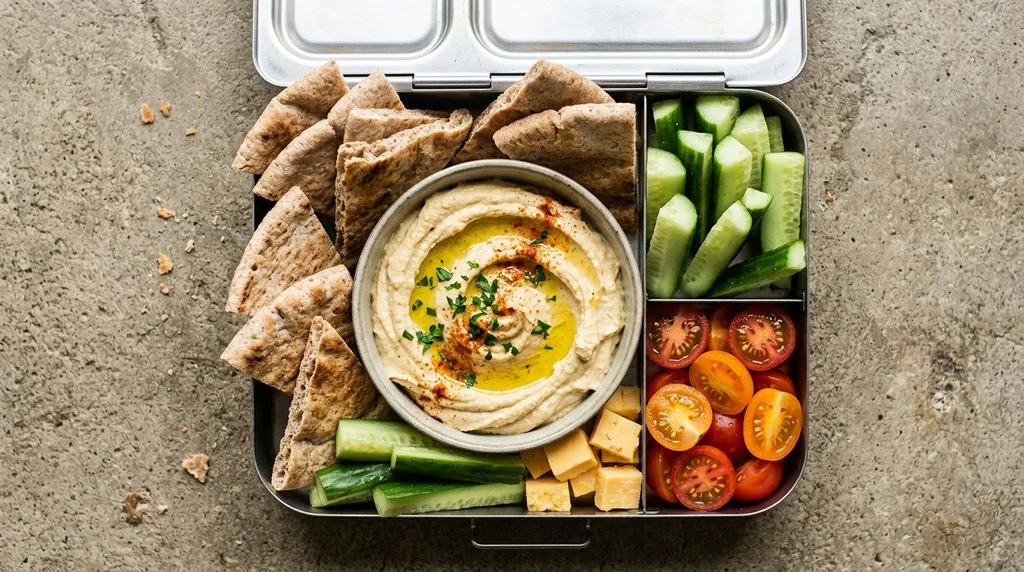
11. The dippers box. Pita cut in triangles, hummus, cucumber sticks, halved cherry tomatoes, cheese cubes. The whole thing is a delivery system for the hummus and that’s fine.
12. Deconstructed sandwich. Bread cut into squares, turkey slices rolled into little logs, cheese, and a small pot of mayo or mustard. Children who reject sandwiches will often eat every component separately.
13. Bagel with a face. Mini bagel halves, cream cheese, cucumber slices and pepper strips packed alongside for them to arrange. The arranging is half the appeal, and it buys eating time.
14. Tuna and crackers, build your own. Tuna mixed with a little mayo in one pot, sturdy crackers in another. Keeping them apart is the entire trick — pre-loaded crackers arrive as paste.
15. Overnight oats with banana coins. Oats, milk and yogurt left in a small jar overnight, banana sliced in the morning so it doesn’t go brown and slippery.
Ten minutes, one appliance
16. Breakfast for lunch. Mini pancakes made from a batch in the freezer, a pot of yogurt to dip them in, blueberries, and turkey sausage cut into coins and then halved again. Wildly popular and almost never refused.
17. Pizza roll-ups. Tortilla, a thin spread of tomato sauce, grated mozzarella, rolled and baked five minutes until it holds together, then cooled and cut. Thin on the sauce or the wrap softens.
18. Mini frittatas. Eggs with whatever cooked vegetable is already in the fridge, baked in a muffin tin. Two of these plus fruit plus crackers is a full lunch.
19. Egg salad in a soft roll. Butter the roll right to the edges first. It sounds fussy and it’s the difference between a sandwich and a wet sponge — the fat blocks the moisture from soaking in.
20. Rice with edamame and chicken. Leftover rice, shelled edamame, diced cooked chicken with a spoonful of mild teriyaki. Good cold, which makes it a genuine five-minute lunch the next day.
Made ahead
21. Chicken and cheese pinwheels. Mix the shredded chicken into softened cream cheese before it goes on the tortilla, rather than layering them. It binds everything so the pinwheels don’t unravel in the box.
22. Pasta salad with cheese and corn. Small pasta shapes, sweetcorn, cheese cubes, a light vinaigrette. Dress it the night before for this one — short pasta actually improves.
Kids Lunch Ideas by Age: Elementary (5–11)
For elementary students, kids lunch ideas by age can be more varied, but familiar shapes, sturdy packing, and quick-to-eat foods still matter.
Two things change here. They can open more or less anything, and they start noticing what everyone else has. A lunch that stands out too much can come home untouched for reasons that have nothing to do with taste. Familiar shapes, packed well, beat adventurous every time at this age.
No cook, five minutes
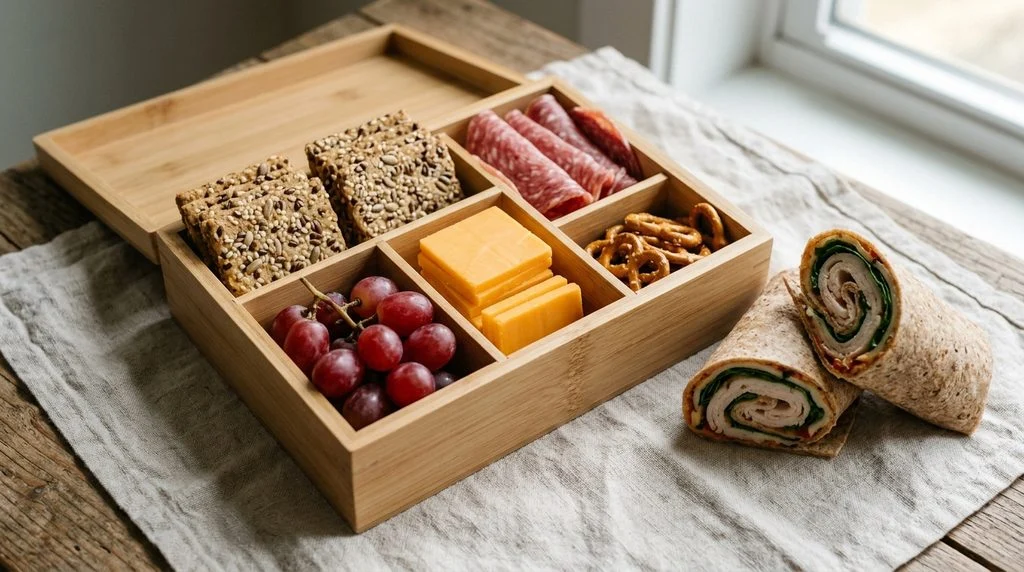
23. The better cracker box. Crackers, salami or ham, cheddar cut into squares the same size as the crackers, grapes, a few pretzels. It’s the shop-bought snack tray, made properly — better cheese, and more of it.
24. Turkey wrap. Tortilla, turkey, cheese, lettuce laid down as a barrier against the mustard, rolled tight and cut on the diagonal so it looks deliberate.
25. Chickpea smash sandwich. Chickpeas crushed roughly with a fork, mayo, a little lemon, salt. Coarse, not smooth — a purée reads as baby food to a nine-year-old.
26. Greek salad box with pita. Cucumber, tomato, olives, feta, dressing in a separate pot, pita cut into strips. Packing the dressing separately is not optional.
27. Deconstructed nachos. Tortilla chips in one pot, bean dip in another, grated cheese and a little salsa alongside. Assembled at the table, so nothing is soggy.
28. Caprese skewers with focaccia. Mozzarella pearls, cherry tomatoes and basil on short skewers, a wedge of focaccia. Check whether skewers are allowed at school first, and blunt them if not.
Ten to fifteen minutes
29. Chicken caesar wrap. Cooked chicken, romaine, parmesan, dressing packed on the side. Chop the lettuce fine and it survives; leave it as whole leaves and it wilts.
30. Cold sesame noodles. Spaghetti or udon, sesame paste or sunflower seed butter thinned with soy, rice vinegar and a little sugar, cucumber matchsticks on top. Better cold than warm, which is rare and useful.
31. Quesadilla wedges with salsa. Mix the filling into the cheese before it goes in the pan so nothing falls out when it’s cut. Salsa separate.
32. BLT, packed in parts. Bacon in one compartment, lettuce and tomato in another, bread and a mayo pot alongside. Built at the table in ten seconds and it tastes like it was made at the table.
33. Curried chicken salad roll. Chicken, mayo, a little curry powder, raisins, celery for crunch. Strong-smelling foods can be a problem at a crowded table, so read the room on this one.
34. Rice bowl from last night’s stir fry. Straight from the fridge, no reheating. Most stir fries are better cold the next day than they have any right to be.
35. Sushi-style rice rolls. Seasoned short-grain rice, cucumber, avocado and cooked crab stick or cooked prawn, rolled in nori and cut thick. No raw fish in a lunchbox, ever — it needs refrigeration a lunch bag can’t guarantee.
Made ahead
36. Pasta salad with salami and broccoli. Use finely chopped raw broccoli rather than a leafy green. Delicate leaves go slimy by noon; broccoli is still crunchy, which is the whole reason to use it.
37. Tortellini pesto salad. Cheese tortellini, pesto, halved cherry tomatoes, a handful of peas. Holds up for three days in the fridge.
38. Burrito in foil. Rice, beans, cheese, whatever meat you have, wrapped tightly in foil. Make eight on a Sunday, freeze them, and move one to the fridge each night.
39. Taco box. Seasoned mince in a preheated thermos, small tortillas, grated cheese and shredded lettuce in separate pots. Assembly is the fun part and it holds their attention long enough to actually eat.
40. Ham and cheese croissants. Split, filled, warmed briefly, cooled fully before wrapping. Wrapping anything warm is how you get condensation and a soft, damp result.
41. Waffle sandwich. Toaster waffles as the bread, ham and cheese or sunflower seed butter and banana inside. Sturdier than sliced bread and it doesn’t go soggy.
42. Pizza muffins. Muffin batter with mozzarella, tomato paste and oregano baked through it. Freeze, defrost overnight.
Kids Lunch Ideas by Age: Middle School & Up (11+)
At this stage, kids lunch ideas by age should become more substantial, portable, and easy for older kids to assemble themselves.
Portions go up a lot, and the goal shifts. They mostly want something substantial, quick to eat, and unremarkable. This is also the age to hand the job over — a twelve-year-old who packs their own lunch eats their own lunch, which is a better outcome than anything you can assemble for them.
43. A proper Italian sub. Salami, provolone, lettuce, tomato, oil and vinegar. Dress the bread, not the filling, and wrap it tightly in paper so it presses slightly. Better at noon than it was at seven.
44. Chicken and rice bowl. Rice, cooked chicken, roasted vegetables, a sauce pot on the side. Scales up endlessly and works cold or from a thermos.
45. Buffalo chicken wrap. Shredded chicken in hot sauce, lettuce, a ranch or blue cheese pot separate, in a large tortilla.
46. Steak and cheese wrap. Thin-sliced leftover steak, provolone, sautéed onion and pepper. A very good use of Sunday’s leftovers.
47. Poke-style bowl. Rice, edamame, cucumber, avocado, sesame, and cooked salmon or cooked prawns. Cooked, packed cold, eaten by noon.
48. Banh mi-style sandwich. Baguette, cooked pork or chicken, quick-pickled carrot and daikon, cucumber, coriander, mayo. The pickle keeps the bread from going dull.
49. Pasta bake slab. Cut a cold square straight from the tray. Sounds unpromising and teenagers eat it happily.
50. Loaded hummus box. A thick layer of hummus in a shallow container, topped with chopped cucumber, tomato, olives, feta and chickpeas, with plenty of pita. Bigger and better than it sounds.
51. Breakfast burrito, from the freezer. Egg, cheese, potato, beans, sausage. Make a dozen, freeze, take one out the night before.
52. The scaled-up protein box. Two eggs, a good handful of cheese, crackers, a whole apple, a handful of nuts if the school allows it. Fast to make, fast to eat, no cooking at all.
Hot Lunches That Actually Stay Hot
These warm kids lunch ideas by age are useful when your child prefers a more substantial meal or gets tired of cold lunch boxes.
Warm meals add more variety to kids lunch ideas by age, especially for older children who want something more filling than a cold box.
A thermos widens the options enormously, and it only works if it’s preheated. Fill it with boiling water, put the lid on, leave it while you heat the food, then tip the water out and add the food piping hot. Skip that and you have a room-temperature lunch by eleven.
Pack anything with noodles or a crisp element separately and let them combine it at the table.
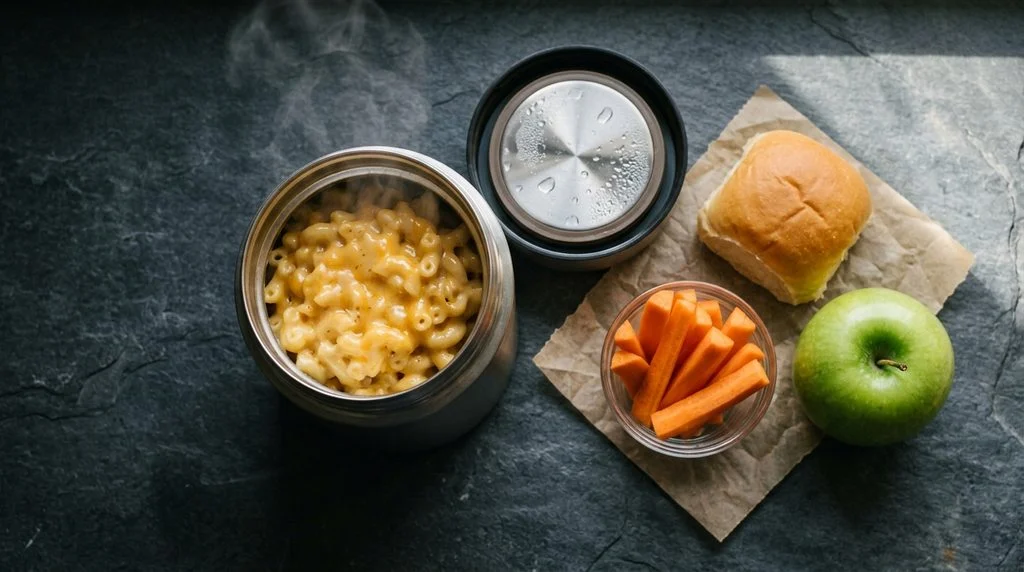
53. Macaroni cheese. Slightly looser than you’d serve at dinner — it thickens in the thermos.
54. Chilli. With a small pot of cheese and a few corn chips on the side.
55. Chicken noodle soup, noodles separate. Otherwise the noodles drink the broth and you’ve sent a bowl of soft pasta.
56. Butter chicken with rice. Rice in the thermos, sauce over it, and it holds beautifully.
57. Meatballs in tomato sauce. With a roll for mopping. No pasta needed.
58. Fried rice. The best possible destination for yesterday’s rice.
59. Ramen, broth and noodles apart. Broth hot in the thermos, cooked noodles and toppings cold in a separate pot, combined at the table.
60. Baked potato with toppings. Baked the night before, split and reheated hot in the morning, with cheese and beans in side pots.
Turn Last Night’s Dinner Into Tomorrow’s Lunch
Leftovers make practical kids lunch ideas by age because the same dinner can be portioned differently for toddlers, elementary students, or older kids.
Leftovers are some of the easiest kids lunch ideas by age because the main cooking is already done and portions can be adjusted for younger or older children.
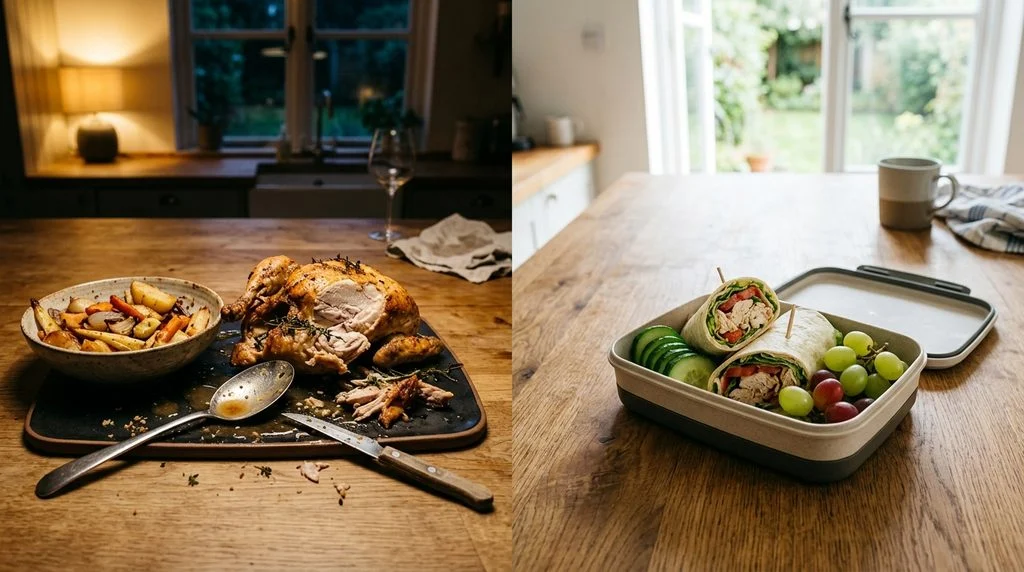
This is the single biggest saving available, and it costs nothing. The trick is to cook with the lunchbox in mind — one extra chicken breast, a cup more rice — and to pack it while you’re clearing up, not the next morning. A lunch packed at 8pm is a lunch you don’t have to think about at 7am.
| Last night | Tomorrow’s lunch | What to do differently |
|---|---|---|
| Roast chicken | Wrap, rice bowl, or chicken salad roll | Shred the meat off the bone while it’s still warm, it’s much easier |
| Taco night | Taco box (#39) or burrito (#38) | Set aside mince before anyone adds sour cream |
| Pasta with sauce | Pasta salad or cold pasta bake slab (#49) | Toss the reserved portion in oil so it doesn’t clump |
| Rice, any meal | Fried rice (#58) or a rice bowl (#44) | Cool and refrigerate rice within an hour, don’t leave it out |
| Steak or grilled meat | Steak and cheese wrap (#46) | Slice against the grain, thinly, while cold |
| Roast vegetables | Rice bowl, frittata (#18), or a grain salad | Keep them separate from anything saucy |
| Sausages | Coins in a bento box, or sliced into pasta salad | Halve the coins lengthwise for younger children |
| Chilli or stew | Thermos lunch (#54) | Portion it hot straight into a container, cool, refrigerate |
| Baked potatoes | Thermos potato (#60) | Bake one extra, refrigerate whole |
| Salmon or white fish | Flake into a rice bowl or pasta | Only if it’ll be eaten the next day, and keep it cold |
| Curry and rice | Thermos (#56) | Loosen with a splash of water, it thickens overnight |
| Boiled or steamed eggs | Any box, any age | Cook six at once on Sunday, keep them in their shells |
No-Cook Kids Lunch Ideas by Age
No-cook kids lunch ideas by age are especially helpful on rushed mornings when there is no time to use the stove or oven.
These no-cook kids lunch ideas by age are useful on rushed mornings when you need fast assembly and very little cleanup.
Useful on the mornings when nothing has been prepped and the bus is in nine minutes. Every one of these is assembly only: #1, #2, #3, #5, #11, #12, #13, #14, #23, #24, #25, #26, #27, #50 and #52.
Between them they cover every age group, so on a bad morning you can start from that list and ignore the rest of the article entirely.
Nut-Free Lunch Ideas for School
These nut-free kids lunch ideas by age can be adjusted to match both school policy and the child’s developmental stage.
Nut-free kids lunch ideas by age are especially useful when daycare or school policies restrict peanuts or tree nuts.
Most schools and nearly all daycares restrict nuts to some degree, and the restrictions vary enormously between districts and sometimes between individual classrooms.
Check your own school’s policy in writing, and if your child has an allergy, follow your allergist’s advice over anything you read here. A “nut-free” label on a package is not a guarantee about the manufacturing line it ran on, and no article can tell you whether a particular product is safe for a particular child.
The straightforward swaps: sunflower seed butter or, where seeds are allowed, tahini in place of peanut butter; pumpkin or sunflower seeds instead of nuts for crunch; roasted chickpeas as a crunchy snack; cheese, eggs, beans, lentils, tuna and yogurt as anchors that were never going to be a problem in the first place.
Two things worth knowing. Sunflower seed butter can turn slightly green where it touches baking soda or baking powder in a baked good — it’s a harmless reaction and looks alarming, so warn your child before they open it. And granola bars, cereals, sauces, pesto and some breads are common hidden sources, so the label is worth reading even on things that seem obviously fine.
If nuts are permitted at your school, a small handful is a genuinely convenient anchor for older children — but not for under-fours, for the reasons in the safety section.
Picky-Eater Lunch Strategies
Picky-eater kids lunch ideas by age work best when the base stays familiar and any new food is introduced in a very small amount.
For selective eaters, the most practical kids lunch ideas by age start with familiar foods and make only small changes at a time.
Lunch is the hardest meal to make progress on, because you’re not there. Which means lunch is the wrong place to introduce anything new. Save that for dinner, at home, where a refusal costs nothing.
Send what they’ll eat. Lunch is fuel for the afternoon, not a teaching opportunity. The narrow, boring, repetitive lunch they finish is a better lunch than the balanced one that comes home.
Change one thing at a time. If they’ll eat a plain turkey sandwich, next month’s version has one thin slice of cheese in it. Not cheese and lettuce and a different bread.
Let them choose within limits. Two options for the anchor, two for the fruit, and they pick. The choosing matters more than the options do.
Look at texture before flavour. A child who refuses tomato in a sandwich may eat cherry tomatoes whole, because the objection was wetness, not tomato. Refusals are usually about texture, temperature or wetness rather than taste, and each of those has a workaround.
Involve them in packing. Even at four, choosing between two containers and putting the grapes in themselves changes how they feel about it at noon.
Keep offering, without pressure. Repeated low-pressure exposure — the food simply being present, with no comment and no requirement to eat it — is the approach with the most evidence behind it. It also takes many more exposures than most parents expect, and pressure reliably makes things worse.
Safety: cutting sizes and keeping food cold
Two separate things, both worth getting right.
Choking risk, especially under four
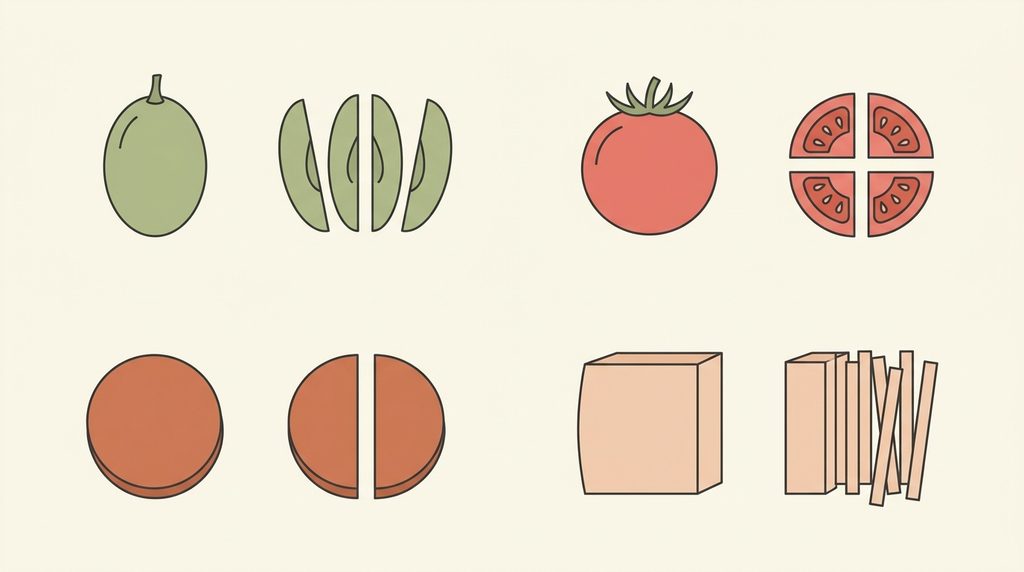
Small round or firm foods are the main hazard for young children, and how you cut them matters more than whether you serve them at all. The foods most often flagged are whole grapes and cherry tomatoes, hot dogs or sausages cut into coins, whole nuts, popcorn, raw hard vegetables like carrot coins, large chunks of cheese or meat, thick spoonfuls of nut or seed butter, whole olives, hard sweets and marshmallows.
The general approach: grapes and cherry tomatoes quartered lengthwise rather than halved across; sausage coins halved again lengthwise so they can’t form a plug; hard vegetables steamed until soft or grated; nut and seed butters spread thin; and nothing hard, round and bite-sized for the youngest group.
Also: no honey at all before twelve months.
These are general points, not a substitute for guidance from your paediatrician or your child’s daycare, and children develop at different rates. If your daycare has its own cutting requirements, theirs win.
Keeping it cold until noon
Most of a packed lunch is perishable — meat, eggs, dairy, cooked rice, cut fruit. It sits in a bag for four or five hours, sometimes in a warm classroom or a cubby by a radiator.
Two cold sources, not one. One ice pack sitting under the food doesn’t do much. Use two, and put one on top of the food and one beside it, because cold air falls.
Use the lunch as its own ice pack. A frozen yogurt pouch, a frozen juice carton or a frozen water bottle keeps everything around it cold and is edible or drinkable by lunchtime.
Chill everything overnight. Packing food that’s still warm, or even at room temperature, means the ice packs spend their whole morning catching up instead of holding.
Never mix hot and cold in the same insulated bag. A hot thermos next to a cold container defeats both. If you’re sending both, they need separate compartments or separate bags.
Wash the bag. Insulated bags get properly unpleasant, particularly if something has leaked. Wipe it out weekly.
Verify the specific temperature range and time limits your local food safety authority publishes, and follow those.
A four-week rotation so you stop deciding
The point isn’t the specific meals — it’s that the pattern repeats, so mornings become execution rather than decision-making. Assign each weekday a format and rotate what fills it.
| Monday | Tuesday | Wednesday | Thursday | Friday | |
|---|---|---|---|---|---|
| Format | Sandwich or wrap | Bento or box | Hot thermos | Leftover-based | Pick-your-own |
| Week 1 | Turkey wrap (#24) | Better cracker box (#23) | Mac and cheese (#53) | Roast chicken rice bowl (#44) | Their choice from the no-cook list |
| Week 2 | Chickpea smash (#25) | Dippers box (#11) | Chilli (#54) | Taco box (#39) | Their choice |
| Week 3 | Caesar wrap (#29) | Greek salad box (#26) | Butter chicken (#56) | Fried rice (#58) | Their choice |
| Week 4 | Egg salad roll (#19) | Deconstructed nachos (#27) | Meatballs (#57) | Cold pasta bake slab (#49) | Their choice |
Two things make it work. Thursday is deliberately tied to whatever Wednesday’s dinner was, so it costs nothing. And Friday is theirs — a lunch they picked, on the day they’re most tired, which buys goodwill for the other four.
Write the format row on a card and stick it inside a cupboard door. That’s the whole system.
The gear that actually matters
Very little of it, in truth, and it’s not what gets marketed.
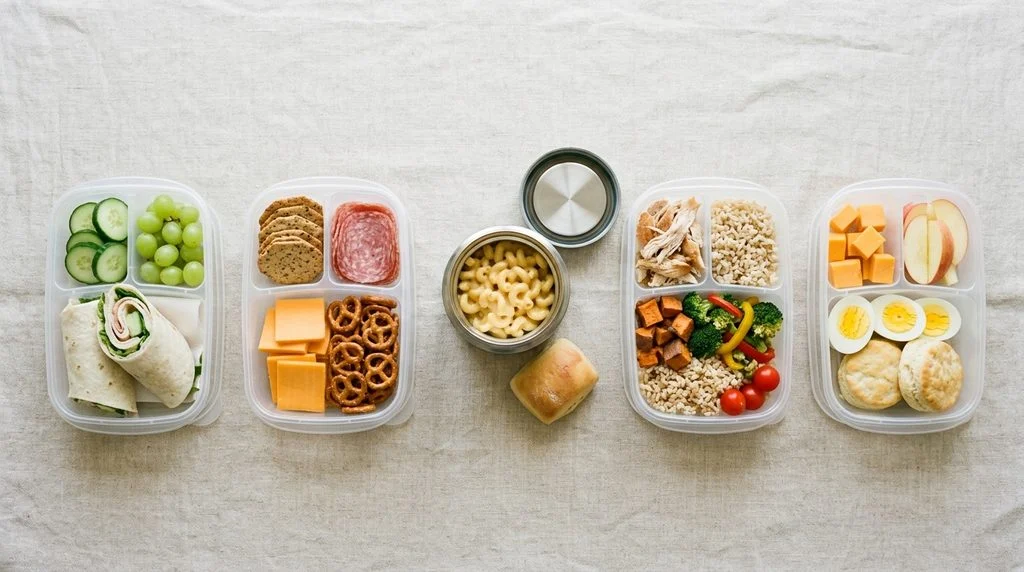
Compartments beat bags. A divided box stops everything touching, which for a lot of children is the difference between eaten and not. It also means fewer bags to open.
They have to be able to open it themselves. Worth repeating because it’s the most common failure. Test each container at home, with your child, before it goes to school. Loosen thermos lids by a quarter turn after you close them.
One good thermos, if you’ll use it. A food thermos — wide-mouthed, not the narrow drinks kind — opens up the entire hot lunch section. If you won’t preheat it, don’t bother buying it.
Two ice packs, slim ones. Slim so they fit alongside the food rather than displacing it.
Silicone cups instead of paper. For separating wet things inside a bigger box. Reusable, and they don’t collapse.
Label everything. Lids especially. Lids are what go missing.
What you don’t need: shaped cutters, bento picks, anything that turns lunch into a craft project. It’s charming for about a week and it doesn’t change how much gets eaten.
What doesn’t work
Worth saying, because some of these are packed daily in good faith.
Sending anything new on a school day. Almost always comes home. Introduce at home, pack once it’s accepted.
Pre-dressed salads and pre-loaded crackers. Both arrive ruined. Pack the wet part separately, every time.
Fruit cut with nothing on it. Apple and pear brown within an hour. A squeeze of lemon or orange juice, or a quick soak in lightly salted water and a rinse, mostly prevents it.
Packing to an adult’s idea of a portion. Too much food reads as a chore. Less, in smaller pieces, gets more eaten.
Assuming a heavily marketed lunchbox snack is a substantial part of lunch. Many bars, yogurt tubes and cheese-flavoured crackers are closer to a treat than to an anchor. They’re fine in slot four. They’re not the lunch. Read the label rather than the front of the box.
Sandwiches with wet fillings and no barrier. Butter to the edges, or a lettuce leaf between filling and bread. This one fix solves most soggy sandwiches.
Blaming the food when the problem is the container, the clock, or the morning snack. Go back to the first section before rewriting the menu.
More Lunch & Snack Guides
Use these related guides when you want to expand your kids lunch ideas by age with broader school-lunch, protein, or snack options.
- For the broadest school-lunch collection, see our 100 school lunch ideas for kids.
- For protein-focused lunchboxes, use our high-protein school lunch ideas.
- For snack-box add-ons, browse our healthy snack ideas for kids.
- For school-safe snack guidance, read our healthy school snacks guide.
Frequently Asked Questions
These quick answers help you adapt kids lunch ideas by age for prep time, food safety, school rules, and picky eating.
How do I pack a lunch a kid will actually eat? Pack something familiar, in pieces small enough to eat quickly, in a container they can open without help, at the right temperature, and in a smaller portion than you think they need. Include one thing they look forward to. Most uneaten lunches fail on one of those five points rather than on the food itself.
What are the easiest kids’ lunch ideas for a busy morning? The no-cook assembly ones: a dippers box with hummus and pita, a deconstructed sandwich of bread squares with turkey and cheese, a cracker-and-cheese box, cottage cheese with soft fruit, or last night’s rice with chicken and vegetables straight from the fridge. All of them are five minutes or less and none needs a pan.
What should I pack for a toddler at daycare? Soft, small pieces, nothing that needs a utensil they haven’t mastered, and nothing round and firm. Cottage cheese with ripe fruit, egg and cheese bites, small pasta with pesto and peas, steamed vegetable sticks with hummus. Ask your daycare for its policy in writing first — many have specific rules about how food must be cut, and some restrict certain foods entirely.
How do I keep a packed lunch cold until lunchtime? Use two cold sources rather than one, place them above and beside the food since cold air falls, chill everything overnight before packing, and never put a hot thermos in the same compartment as cold food. A frozen yogurt pouch or drink doubles as an ice pack and gets eaten. Check the time and temperature limits published by your local food safety authority.
How do I keep a sandwich from going soggy? Butter or spread right to the edges to create a fat barrier, or lay a lettuce leaf between a wet filling and the bread. Pack tomato and cucumber separately and let them add it. Toasted bread holds up better than fresh.
What can I pack that’s nut-free? Sunflower seed butter instead of peanut butter, seeds instead of nuts, and anchors that were never nut-based anyway: eggs, cheese, beans, lentils, tuna, chicken, yogurt. Check labels on granola bars, cereals, breads, pesto and sauces, where nuts are a common hidden ingredient. Confirm your school’s specific policy, and follow your allergist if your child has an allergy.
My child won’t eat lunch at school at all. What now? Check the practical things first: how long they actually get to eat, whether they can open everything, and whether morning snack is filling them up. Then send only foods you know they accept, and stop using lunch to introduce anything. If they’re consistently not eating and it’s affecting their weight, energy or mood, talk to your paediatrician rather than working through it alone.
How far ahead can I make lunches? Most assembled boxes are good for two to three days in the fridge. Wraps and sandwiches are best made the night before rather than earlier. Burritos, egg bites, muffins, patties and pancakes all freeze well, so a Sunday batch covers several weeks if you move one to the fridge the night before.
Final Thoughts on Kids Lunch Ideas by Age
A small rotation of reliable kids lunch ideas by age is usually more sustainable than trying to invent a completely different lunch every day.
The most useful kids lunch ideas by age are the ones that match your child’s eating skills, school setting, appetite, and the amount of prep time you realistically have. Keep a small rotation of reliable options, then use this list when that rotation starts to feel stale.
This article is general information, not medical or nutritional advice. Choking risk, food allergies and how much a child needs vary by age and by individual. Talk to your paediatrician, your allergist or a registered dietitian about your own child, and follow your school’s or daycare’s policies where they differ from anything here.