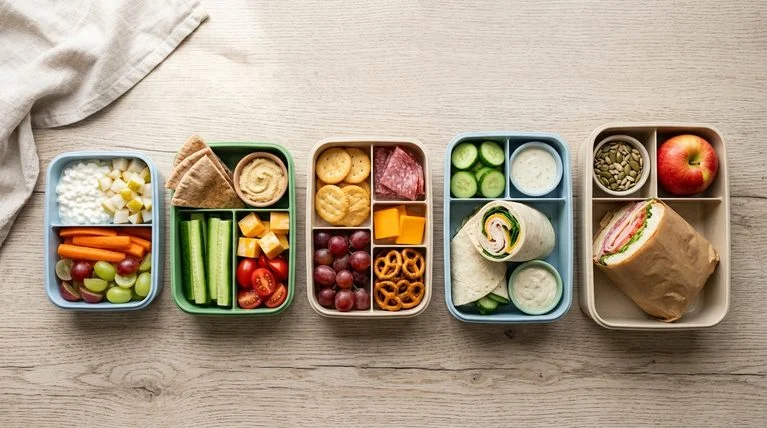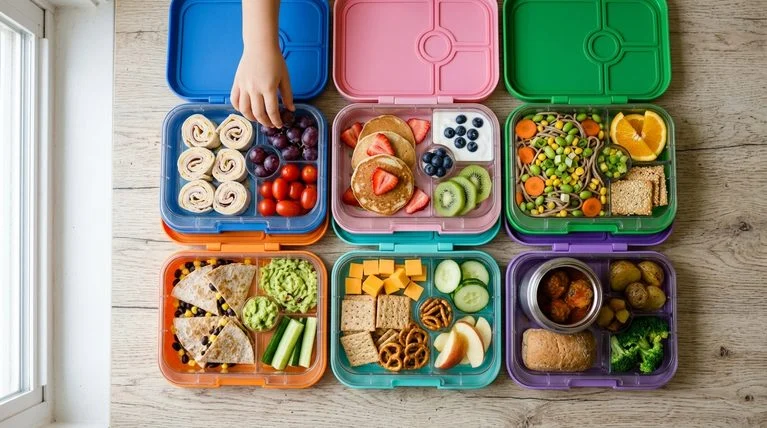
45 High-Protein School Lunches for Kids
Quick choices for high-protein school lunches include egg-and-cheese boxes, Greek yogurt with seeds, chicken wraps, tuna and crackers, bean or lentil salads, tofu bowls, and cottage-cheese combinations.
Use these high-protein school lunches as a rotation rather than trying to serve a completely different lunch every day.
For the simplest high-protein school lunches, rotate a few dependable protein anchors such as eggs, Greek yogurt, chicken, cheese, beans, lentils, tofu, or tuna, then add fruit, vegetables, and a familiar carbohydrate.
These high-protein school lunches are built for real school mornings: quick assembly, enough staying power for the afternoon, and clear protein amounts so you can see what each lunch actually provides.
This guide includes 45 high-protein school lunches organized by effort — five-minute no-cook boxes, 15-minute builds, and make-ahead options you can prep on the weekend. You will also find nut-free choices, picky-eater ideas, meal-prep guidance, and food-safety tips for keeping protein-rich lunches cold or hot until lunchtime.
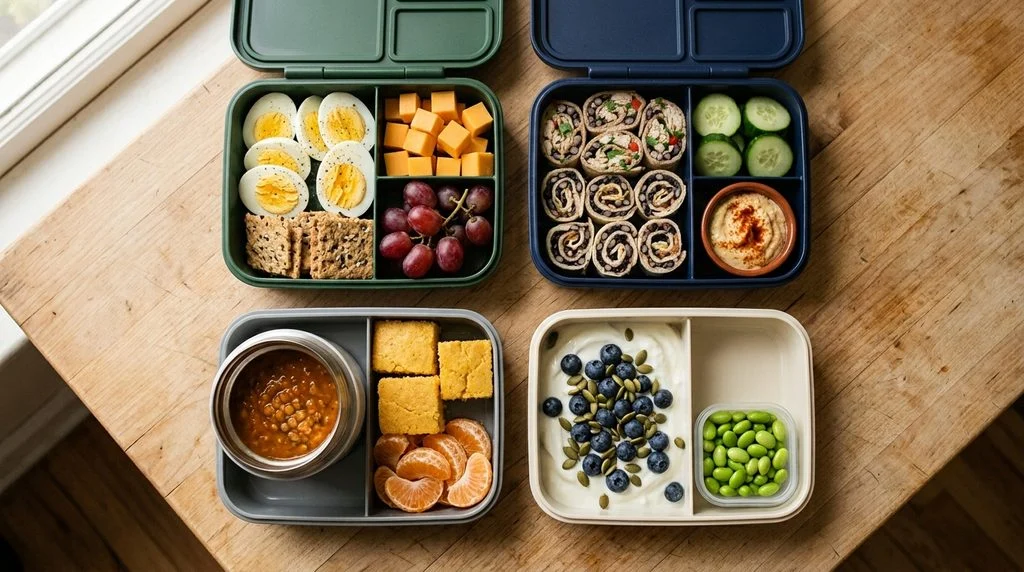
So this guide is organised by effort, not by food category. Tier 1 is assembly only — no heat, no pan, nothing to wash. Tier 2 needs one appliance and about fifteen minutes. Tier 3 is a single weekend session that quietly feeds you all week.
Two things you’ll find here that most lunchbox roundups skip. First, every idea has its protein grams attached, because “protein-packed” means nothing if a lunch lands at 6 grams. Second, there’s a real food-safety section — chicken salad that sat at room temperature until noon is not a win, and almost nobody writing these lists mentions it.
How Much Protein Does a Kid Need at Lunch?
For most families, the easiest way to build high-protein school lunches is to choose the protein first, then add familiar sides around it.
When planning high-protein school lunches, the easiest approach is to start with one clear protein source and build the rest of the lunch around it.
The goal of high-protein school lunches is not to chase a perfect number, but to include a meaningful protein anchor that helps make the meal more filling and practical.
Two different numbers get muddled here, and they’re worth separating.
The first is the daily minimum — the amount needed to prevent deficiency. The second is the practical lunch target — the amount that actually keeps a child full and focused through the afternoon. The second is higher, and it’s the one to aim at.
| Age | Daily protein RDA (approx.) | Practical lunch target |
|---|---|---|
| 4–8 years | ~19 g | 10–14 g |
| 9–13 years | ~34 g | 15–20 g |
| 14–18 years (girls) | ~46 g | 20–25 g |
| 14–18 years (boys) | ~52 g | 25–30 g |
A useful shortcut: most kids land in the right range at 15 to 20 grams, and the formula below gets you there almost every time.
The 20-gram formula
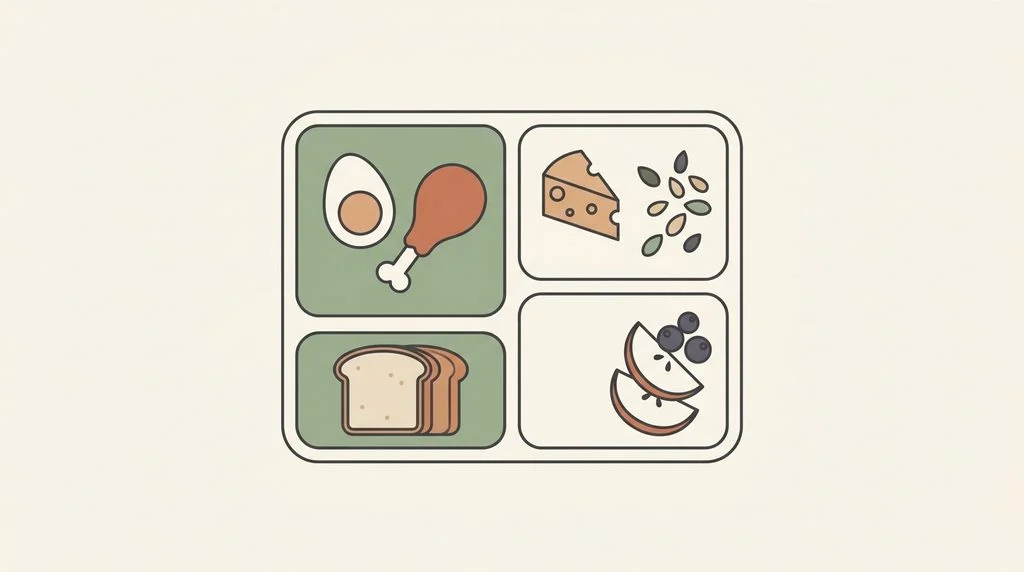
Stop inventing lunches. Build them from four slots:
- One anchor protein — 10 to 20 g. Eggs, chicken, tuna, Greek yogurt, cottage cheese, beans, lentils, tofu, deli meat.
- One supporting protein — 4 to 8 g. Cheese, seeds, a bean salad, a milk box, hummus.
- One real carbohydrate — bread, tortilla, pasta, rice, crackers, a muffin. This is fuel, not filler.
- One or two things they’ll actually eat — fruit, cucumber coins, a few pretzels, something small and sweet.
Anchor plus support clears 15 g nearly every time. That’s the whole trick. Once it’s in your head, the ideas below stop being recipes and start being combinations you can improvise.
Tier 1: Zero-cook, five minutes or less
Nothing here needs heat. If a stove is involved, it isn’t in this tier. These are assembly jobs — open, portion, close.
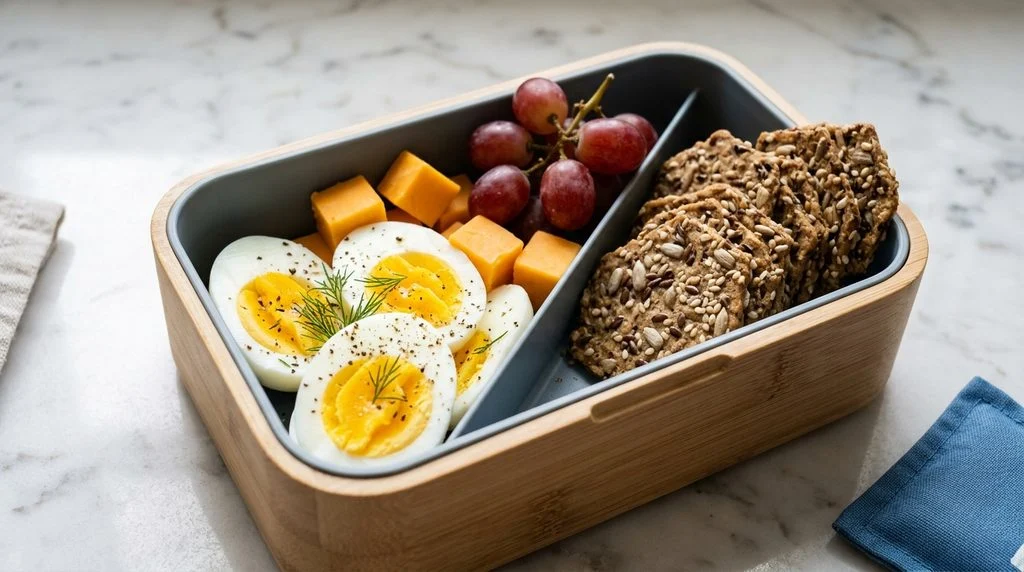
1. The classic protein box. Two hard-boiled eggs, an ounce of cubed sharp cheddar, seeded crackers, grapes. About 19 g. Steam a dozen eggs on Sunday (see #32) and this becomes a thirty-second lunch.
2. Cottage cheese and fruit cup. Half a cup of cottage cheese with peaches or pineapple, granola packed separately so it stays crunchy. About 14 g before the granola.
3. Greek yogurt parfait. Three-quarters of a cup of plain Greek yogurt, a swirl of honey or jam, berries, a tablespoon of pumpkin seeds on top. About 18 g. Plain yogurt plus your own jam has far less sugar than the flavoured tubs and costs less per gram of protein.
4. Turkey and cheese pinwheels. Tortilla, cream cheese, two ounces of deli turkey, a shingle of cheese. Roll tight, chill ten minutes if you have them, slice into rounds. About 18 g — and the spiral shape does a surprising amount of work with younger kids.
5. Tuna salad with crackers. A single-serve pouch of tuna mixed with mayo or yogurt and a little dill relish, packed beside sturdy crackers. About 22 g. Pouches skip the draining step entirely.
6. Chickpea smash sandwich. Mash half a cup of chickpeas with mayo, lemon and salt — it reads like tuna salad to a kid who won’t touch fish. About 15 g with two slices of bread. Add a cheese stick to clear 20.
7. Edamame snack box. A cup of shelled edamame with flaky salt, plus a string cheese and a mandarin. About 24 g — edamame is quietly one of the highest-protein things you can tip into a container. Frozen shelled edamame thaws to perfect eating temperature by noon and doubles as a cold pack.
8. Ham and cheese roll-ups, no bread. Sliced ham wrapped around cheese sticks, packed with pretzels, cucumber and ranch. About 17 g. The bread-refusers’ lunch.
9. Hummus and pita plate. Half a cup of hummus, pita triangles, carrot sticks, olives, and a hard-boiled egg for the anchor. About 18 g. Note where that comes from: hummus is only about 4 g per quarter cup, so it’s a supporting protein, not an anchor. A lot of “protein lunch” boxes are quietly built on that misunderstanding.
10. Peanut butter and banana roll-up. Tortilla, two tablespoons of peanut butter, a whole banana, rolled and sliced. About 12 g. Add a milk box and you’re at 20.
11. The kid charcuterie box. Turkey pepperoni or salami, cubed cheese, crackers, apple slices, a few nuts if school policy allows. About 19 g. Extremely popular and extremely lazy — the best combination there is.
12. Ricotta toast, packed cold. Whole-grain bread spread thick with half a cup of ricotta, honey drizzled over, cinnamon on top. About 18 g and unexpectedly good at room temperature.
13. Cowboy caviar. Black beans, black-eyed peas, corn, tomato, red onion, bell pepper and scallion in a lightly sweet vinaigrette. About 12 g a cup. Send scoop-shaped corn chips alongside so it becomes a dip rather than a salad — the reframing matters to a nine-year-old. Better on day two, holds four days.
14. Pimento cheese with crackers and cucumber. Sharp cheddar, mayo, cream cheese and diced pimentos. About 14 g for a third of a cup with crackers. One of the highest protein-per-effort spreads in the fridge.
15. White bean caprese. Half a cup of cannellini beans, an ounce of mini mozzarella balls, halved cherry tomatoes, olive oil, salt. About 13 g — add a slice of bread or a second ounce of mozzarella to clear 20. Leave the basil out or pack it separately; torn basil goes black and slimy in a box by noon.
16. Deconstructed egg salad. Sliced hard-boiled eggs, a small pot of seasoned mayo for dipping, bread on the side. Same nutrition as egg salad, none of the texture kids object to. About 17 g.
Tier 2: One appliance, about fifteen minutes
Now there’s a pan, a toaster oven or an air fryer involved. Still weeknight-doable — either the evening before, or during the morning scramble if you’re the sort of person who can manage that.
17. Cottage cheese egg bites. Blend eight eggs with half a cup of cottage cheese, stir in cheese and whatever vegetable is dying in the crisper, bake in a muffin tin at 375°F for about 18 minutes. Two bites, about 14 g. The cottage cheese is what keeps them light instead of rubbery. Makes twelve and freezes well. Swap in diced ham and scallion for a savoury-muffin version.
18. Sheet-pan chicken strips. Toss chicken tenders in oil, paprika and salt; roast at 425°F for 18 to 20 minutes. Three ounces, about 26 g. Pack cold with a dipping sauce — cold roast chicken is genuinely good, unlike cold breaded nuggets.
19. Thermos mac and cheese with white beans. Purée half a cup of white beans into the cheese sauce. Nobody notices, the colour doesn’t change, and it adds around 7 g on top of the pasta and cheese. Total near 20 g.
20. Quesadilla triangles. Tortilla, shredded cheese, black or refried beans, four minutes in a dry pan. About 17 g. If you’re adding chicken, toss the chicken and cheese together in a bowl before it goes in the tortilla — it melts evenly and the filling stops falling out when it’s cut.
21. Turkey meatballs in a thermos. Simmer make-ahead meatballs in marinara and send them hot in a preheated thermos with a soft roll. Four small meatballs, about 20 g.
22. Fried rice with egg and peas. Yesterday’s rice, two scrambled eggs, frozen peas, soy sauce, sesame oil. Six minutes in a hot pan. About 16 g.
23. Everyday dal with rice. Red lentils, turmeric, garlic, a knob of butter, simmered about ten minutes until they collapse. About 18 g with rice, and it genuinely improves for three days — one pot on Sunday covers most of the week. The cheapest anchor protein on this entire page.
24. Lentil tomato soup with a cheese sandwich. Brown a little butter before the tomatoes go in; it’s the difference between fine and very good. Soup in the thermos, half a cheese sandwich alongside. About 19 g and the best cold-weather lunch here.
25. Crispy tofu cubes. Press firm tofu, cube it, toss with cornstarch, tamari, garlic and onion powder, then air-fry at 400°F for 12 minutes (or bake at 425°F for 25) until the edges are properly crisp. Four ounces, about 10 g; add rice and edamame to reach 20. The crisp exterior is the entire reason a tofu-skeptical kid will try it — soft tofu in a lunchbox is a lost cause.
26. Egg salad on a toasted mini bagel. Two eggs, mayo, mustard, chives. About 17 g. The anti-sog method, which matters more than the recipe: toast the bread, butter it thinly right to the edges, then lay a lettuce leaf on each slice before the filling goes in. Butter and lettuce are both moisture barriers. Four hours later it’s still a sandwich.
27. Chicken and cheese taquitos. Roll shredded chicken and cheese in corn tortillas, bake at 425°F for 15 minutes until they hold their shape. Two taquitos, about 18 g. Freeze a tray raw and bake from frozen.
28. Salmon patties. Canned salmon, egg, breadcrumbs, lemon zest; pan-fry four minutes a side. One patty, about 18 g, and the omega-3s are a bonus you don’t have to mention out loud.
29. Dumpling and smashed cucumber salad with peanut sauce. Boil frozen chicken or vegetable dumplings, cool them, toss with smashed cucumber and a peanut-soy-vinegar dressing. About 20 g. Cold dumplings are better than they sound, and this is the rare lunch that improves while it sits. Pack the sauce separately if your kid is texture-sensitive.
30. Baked falafel with tzatziki. Blitz chickpeas with herbs and garlic, bake at 400°F for 20 minutes. Four falafel with yogurt sauce and pita, about 16 g.
31. Breakfast-for-lunch box. Two scrambled-egg wraps, turkey sausage links, fruit. About 24 g. Kids treat this as a small act of rebellion, which is useful.

Tier 3: One weekend session, five lunches
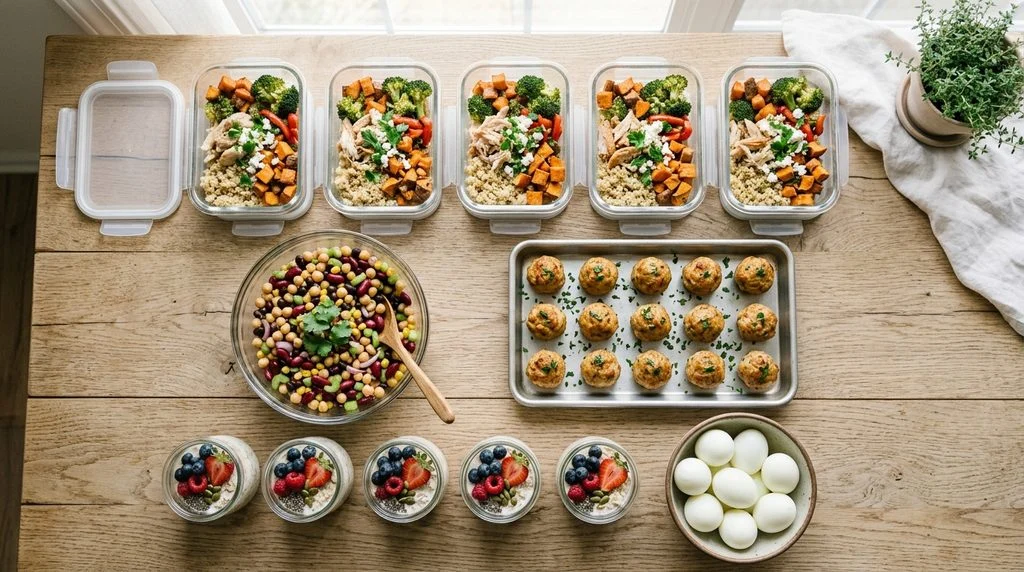
This is where the actual leverage is. Forty-five minutes on Sunday and the weekday job shrinks to opening containers.
32. Batch-steamed eggs. Skip the big pot of boiling water. Bring an inch of water to a hard boil, lower in a dozen cold eggs in a steamer basket, lid on, eleven minutes, then straight into ice water. Steam penetrates the shell more gently than a rolling boil, so you get no grey ring and the shells slip off cleanly. About 6 g each. Store peeled and submerged in water in a sealed container and they stay good all week without going rubbery.
33. Rotisserie chicken, three ways. One store-bought bird becomes chicken salad, taco filling and wrap meat. Shred it all and portion it on Sunday. About 25 g a portion.
34. Lemon-turmeric chicken salad. Shredded chicken in a dressing of half Greek yogurt, half mayo, with lemon, garlic and turmeric. About 22 g. The yogurt keeps it from going gloopy and the turmeric makes it look like something other than beige chicken salad on day three.
35. Overnight oats with Greek yogurt. Oats, milk, Greek yogurt, chia, in five jars. About 15 g each. Vary the topping so Thursday doesn’t feel like Monday.
36. Frozen burrito bank. Assemble ten bean-and-cheese burritos with ground turkey or chicken, wrap individually in foil, freeze. About 18 g each. Move one to the fridge the night before, reheat in the morning, send it in a preheated thermos.
37. Sheet-pan meatball tray. Forty meatballs, one tray, twenty minutes. Freeze in portions of four. About 20 g a portion.
38. Marinated bean salad. A large batch of chickpeas, white beans, red onion and vinaigrette. Holds five days and improves for the first three. About 12 g a cup.
39. Tortellini pasta salad with salami. Cheese tortellini, chopped salami, roasted red pepper, vinaigrette. About 21 g. One critical swap: use roughly chopped raw broccoli instead of arugula or spinach. Delicate leaves turn to slime in a lunchbox by noon, while broccoli just softens pleasantly as it sits in the dressing. Same trick works for a tuna-and-pea pasta salad at about 20 g.
40. Cottage cheese pancakes, frozen. Blend cottage cheese into the batter, make a double stack, freeze flat with parchment between them. Three pancakes, about 16 g.
41. Chicken and quinoa bowls. One big pot of quinoa, topped with chicken, roasted vegetables and dressing, in five containers. About 24 g each.
42. Homemade energy bars. Oats, dates, nut or seed butter, a little honey, salt, pressed into a pan and chilled. About 8 g a bar. Worth making rather than buying, because most supermarket bars marketed at kids sit at 3 to 5 g of protein and a lot of sugar — they’re a biscuit with a health claim. Treat these as a supporting protein, never the anchor.
43. Lentil soup, frozen in portions. One pot, six thermos-sized containers. About 18 g a serving.
44. Freezer smoothie packs. Portion frozen fruit, spinach and Greek yogurt into bags; blend in ninety seconds on the day and freeze the bottle overnight so it thaws into a cold drink. About 20 g. Pair it with something solid so lunch isn’t liquid-only. Check with your paediatrician before giving a child protein powder — for most kids, yogurt or milk does the same job without the guesswork.
45. Homemade yogurt tubes. Fill reusable pouches with Greek yogurt and blended fruit and freeze them standing up. About 12 g each, and they double as the ice pack for the rest of the box.
The lunchbox protein cheat sheet
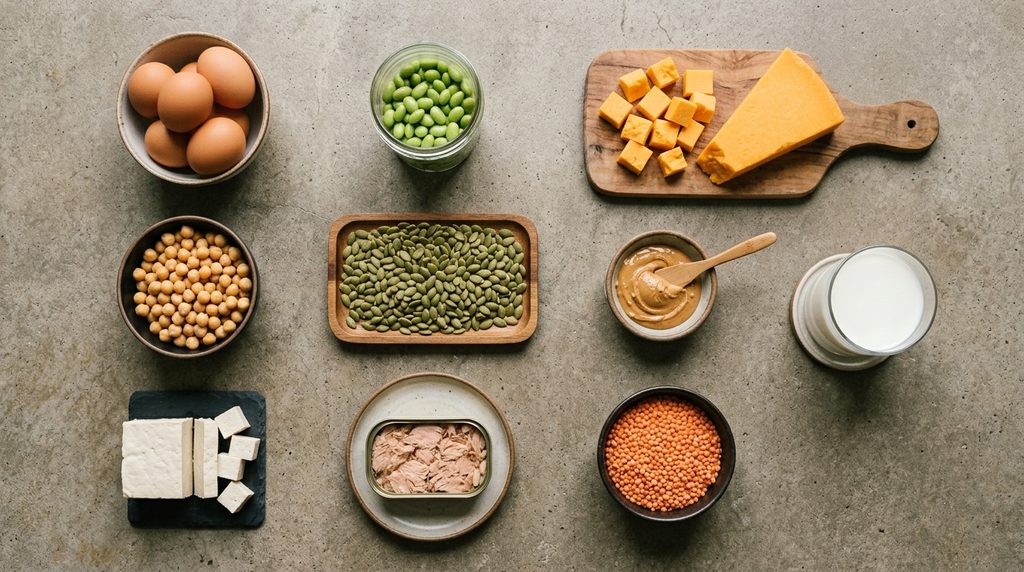
Print this and stick it inside a cupboard door. Once you know roughly what things are worth, you stop needing recipes.
Anchor proteins (10 g and up)
| Food | Portion | Protein |
|---|---|---|
| Chicken breast, cooked | 3 oz | ~26 g |
| Canned tuna, drained | 3 oz | ~20 g |
| Shelled edamame | 1 cup | ~18 g |
| Canned salmon | 3 oz | ~17 g |
| Greek yogurt, plain | ¾ cup | ~17 g |
| Ricotta | ½ cup | ~14 g |
| Cheese tortellini | 1 cup | ~14 g |
| Cottage cheese | ½ cup | ~13 g |
| Eggs | 2 large | ~12 g |
| Deli turkey or ham | 2 oz | ~10 g |
| Firm tofu | 4 oz | ~10 g |
| Cooked lentils | ½ cup | ~9 g |
Supporting proteins (4 to 9 g)
| Food | Portion | Protein |
|---|---|---|
| Pumpkin seeds (pepitas) | 1 oz | ~9 g |
| Turkey pepperoni | 1 oz | ~9 g |
| Milk | 1 cup | ~8 g |
| Cheddar | 1 oz | ~7 g |
| Peanut butter | 2 tbsp | ~7 g |
| Black beans or chickpeas | ½ cup | ~7 g |
| String cheese | 1 stick | ~6 g |
| Sunflower seed butter | 2 tbsp | ~6 g |
| Almonds | 1 oz (~23) | ~6 g |
| Hemp hearts | 2 tbsp | ~6 g |
| Whole-grain bread | 1 slice | ~4 g |
| Cooked pasta or quinoa | ½ cup | ~4 g |
| Hummus | ¼ cup | ~4 g |
The ones that fool people
| Food | Portion | Protein |
|---|---|---|
| Flour tortilla | 8-inch | ~4 g |
| Kids’ “protein” snack bar | 1 bar | ~3–5 g |
| Fruit-flavoured yogurt tube | 1 tube | ~2–3 g |
| Cooked white rice | ½ cup | ~2 g |
| Cream cheese | 2 tbsp | ~2 g |
| Fruit, any | 1 serving | ~0–1 g |
Nut-free ideas that pass school policy
Most schools now restrict nuts somewhere on the spectrum from “no peanuts” to “nothing that has ever met a nut.” Nut butters are the default protein crutch for a lot of parents, so losing them hurts. These swaps don’t.
Sunflower seed butter is the direct substitute — around 6 g for two tablespoons, and it behaves like peanut butter in every roll-up and sandwich above. Buy it once and stop thinking about it.
Pumpkin seeds are the highest-protein seed you can throw at a lunchbox at roughly 9 g an ounce, and they’re crunchy in a way that scratches the same itch as nuts. Roasted chickpeas do a similar job at about 6 g.
Beans, eggs, dairy and meat were never the problem. Every idea in Tier 1 except #10 and #11 is already nut-free, and the whole of Tier 3 is nut-free apart from the energy bars, which work perfectly with seed butter instead.
Watch the hidden ones. Granola, some pestos, most “trail mix” style snack bars, and a lot of Asian sauces including satay and some hoisin. Read the label on anything processed rather than assuming — this is the category where parents get caught out.
Dairy-free, vegetarian and vegan swaps
Dropping dairy takes out yogurt, cheese and milk, which is a lot of the easy grams. Lean harder on beans and lentils (dal at #23 is vegan if you swap the butter for oil, and cowboy caviar at #13 already is), crispy tofu at #25, edamame at #7 without the string cheese, and seeds everywhere. A cup of soy milk is roughly 7 g and is the only plant milk that reliably matches dairy — most almond and oat milks sit near 1 to 3 g, which is worth knowing if you’ve been treating a milk box as a supporting protein.
For vegetarian kids who do eat dairy, nothing changes much: cottage cheese, Greek yogurt, ricotta, eggs and cheese carry the whole list, and #6, #9, #13, #15, #17, #19, #23, #25, #30, #38 and #40 are all already there.
Read More: High-Protein Breakfast Ideas for Kids
The picky-eater playbook
Protein refusal is usually about texture, not nutrition. Five things that reliably work:
Deconstruct it. Sliced eggs with dip instead of egg salad; chicken and cheese side by side instead of mixed. Kids who reject mixtures often eat every component happily. That’s the entire logic behind #16.
Make it crunchy. Crisp is the most accepted texture in childhood. Baked tofu, roasted chickpeas, taquitos and pan-fried patties get eaten where the soft version of the same protein comes home untouched.
Change the shape, not the food. Pinwheels, cubes, skewers, mini versions. It’s absurd how much this works and it costs nothing.
Hide it in a sauce, not in a solid. Puréed white beans in cheese sauce, red lentils in tomato soup, cottage cheese blended into pancake batter — all invisible. Chunks of the same ingredient get found and removed with forensic precision.
Send a dip. Ranch, ketchup, hummus, yogurt sauce, peanut or seed sauce. Kids will eat almost any protein if there’s something to dunk it in, and the dip usually adds a gram or two itself.
One more, and it’s the one that actually matters over a school year: serve the new thing next to something safe, and don’t comment on it. Repeated low-pressure exposure is the only approach with real evidence behind it.
Keeping it safe until noon
This is the part almost every high-protein lunch list leaves out, which is strange, because protein foods are exactly the ones that spoil. Eggs, chicken, tuna, yogurt, cottage cheese and mayonnaise-based salads are all genuinely perishable, and a lunch packed at 7 a.m. is not eaten for five hours.
The rule to remember: perishable food shouldn’t sit between roughly 40°F and 140°F (4°C to 60°C) for more than two hours total. A lunchbox at room temperature blows straight through that window before the bell rings for lunch.
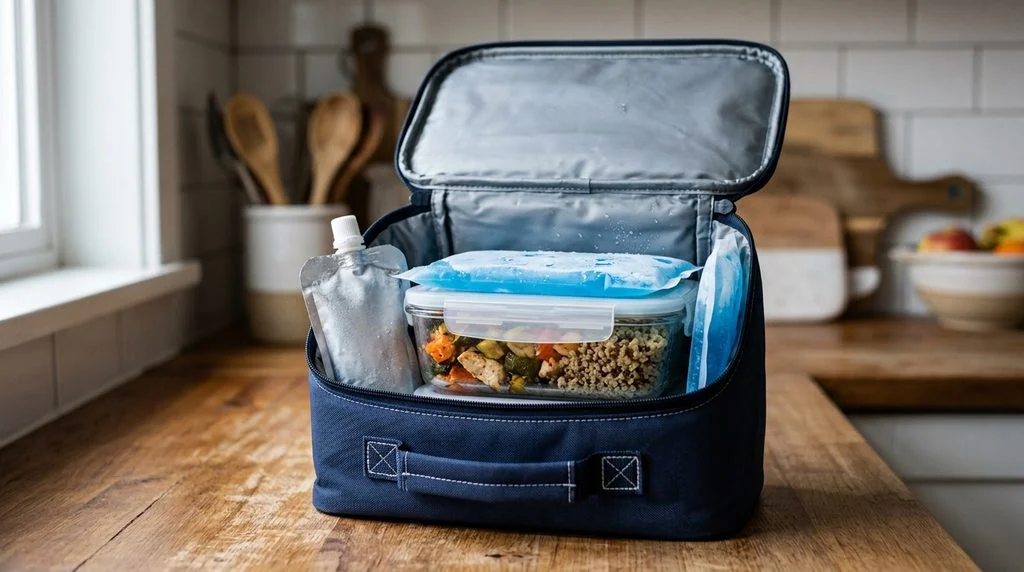
For cold food, use two cold sources. One ice pack is not enough for a five-hour hold in an insulated bag. Use two, and place them on top of and beside the food rather than underneath — cold air sinks. A frozen yogurt pouch, a frozen juice box or frozen edamame each count as one, and they thaw into part of lunch.
For hot food, preheat the thermos. Fill it with boiling water, cap it, leave it five to ten minutes, tip it out, then add food that is properly hot — steaming, not warm. A cold thermos filled with hot soup lands in the danger zone within the hour. Done properly, soup and dal stay genuinely hot until lunch, and this is what makes Tier 2 workable at all.
Send an insulated bag, not a paper sack. The bag is doing most of the work; the ice packs just keep it going.
What to do with leftovers coming home. If a protein lunch comes back uneaten and the ice packs are already soft, throw it out rather than putting it back in the fridge. It’s annoying and it’s the right call.
Lower-risk options for the days you forget the ice pack: hummus and pita, bean salads, nut or seed butter sandwiches, hard cheese, and shelf-stable tuna pouches eaten straight. Not zero-risk, but far more forgiving than chicken salad.
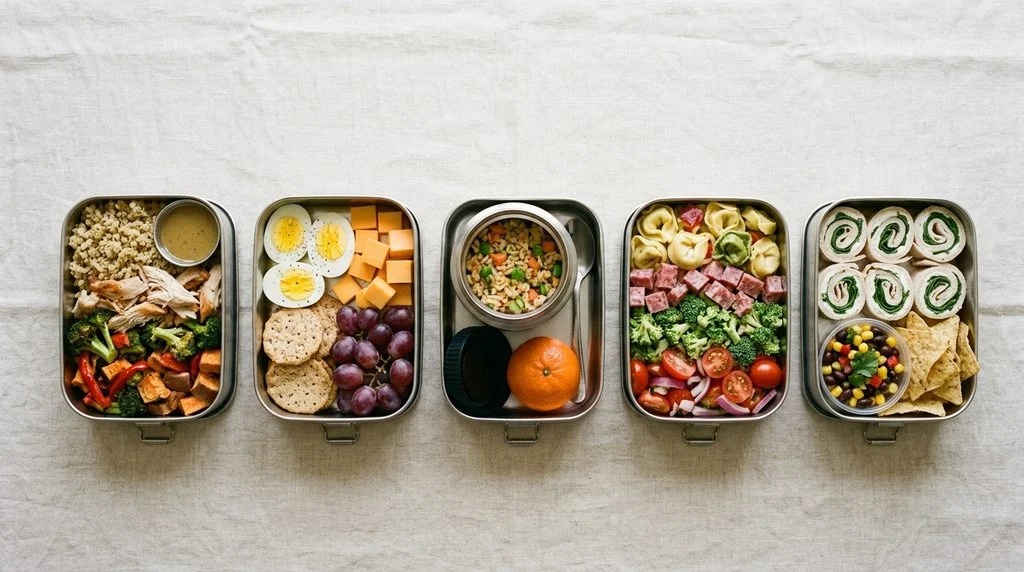
A five-day plan that doesn’t repeat itself
One Sunday session, five different lunches, every day over 15 g.
| Day | Anchor | Support | Carb | Extra | Protein |
|---|---|---|---|---|---|
| Monday | Chicken and quinoa bowl (#41) | — | quinoa | roasted veg | ~24 g |
| Tuesday | Two steamed eggs (#32) | cheddar cubes | seeded crackers | grapes | ~19 g |
| Wednesday | Dal in a thermos (#23) | yogurt pouch (#45) | rice | clementine | ~30 g |
| Thursday | Tortellini salad with salami (#39) | — | tortellini | apple slices | ~21 g |
| Friday | Turkey pinwheels (#4) | cowboy caviar, ½ cup (#13) | tortilla | corn chips | ~24 g |
Sunday’s actual work: steam a dozen eggs, cook one pot of dal, cook quinoa and shred a rotisserie chicken, boil tortellini and dress the salad, fill five yogurt pouches. Everything else is assembly on the day.
What doesn’t deliver
Snack bars marketed as protein for kids. Most land at 3 to 5 g — less than a slice of cheese, with considerably more sugar. Fine as a treat, useless as an anchor. Make #42 instead.
Yogurt tubes and fruit-flavoured yogurt cups. Often 2 to 3 g and a lot of added sugar. Plain Greek yogurt with your own fruit does the same job at five or six times the protein.
Deli meat alone. Two ounces is only about 10 g, so it needs a partner — cheese, a milk box, a bean salad — to clear the target. This is the single most common near-miss lunch.
Hummus as the anchor. Around 4 g a quarter cup. It’s a support, not a base, and a lot of “protein lunch” boxes are built on this misunderstanding.
“Protein” bread, pasta and cereal. Usually a gram or two more than the standard version at twice the price. Put the money into eggs, lentils or yogurt.
More Lunch & Snack Guides
If you want more variety beyond high-protein school lunches, these related guides cover broader school lunches, age-based ideas, and snack options.
- For a broader collection, see our 100 school lunch ideas for kids.
- For age-specific lunch planning, use our kids lunch ideas by age.
- For snack-box add-ons, browse our healthy snack ideas for kids.
- For school snack rules and food-group guidance, read our healthy school snacks guide.
Frequently Asked Questions
These FAQs make it easier to adapt high-protein school lunches for nut-free schools, picky eaters, meal prep, and busy mornings.
These FAQs cover practical questions about high-protein school lunches, including nut-free choices, picky eaters, meal prep, and storage.
These answers cover the most common questions about high-protein school lunches, including nut-free options, picky eaters, meal prep, and protein amounts.
How much protein should a school lunch have? Aim for 15 to 20 g for most primary and middle-school children, and 20 to 30 g for teenagers. That’s above the strict daily minimum split three ways, because the goal is staying full through the afternoon, not just avoiding deficiency. The 20-gram formula above — one anchor protein plus one supporting protein — gets you there without weighing anything.
What are the highest-protein foods for a lunchbox? Per lunchbox-sized portion: cooked chicken breast (~26 g in 3 oz), canned tuna (~20 g in 3 oz), shelled edamame (~18 g a cup), plain Greek yogurt (~17 g in ¾ cup), cottage cheese (~13 g in ½ cup) and eggs (~6 g each).
How do I keep a high-protein lunch cold until lunchtime? Use an insulated bag with two cold sources placed on top of and beside the food, not underneath. Perishable food shouldn’t spend more than about two hours between 40°F and 140°F, and a five-hour school morning needs real help to stay under that. Frozen yogurt pouches and frozen edamame work as ice packs and as food.
What are good high-protein school lunches without nuts? Sunflower seed butter roll-ups, pumpkin seeds, roasted chickpeas, cowboy caviar, dal, egg-based boxes, cottage cheese egg bites, cheese and deli meat roll-ups, tortellini salad with salami, and Greek yogurt parfaits. Almost everything in Tier 1 and Tier 3 here is already nut-free.
What’s the best high-protein lunch for a picky eater? Deconstructed and crunchy versions of things they already tolerate: sliced eggs with a dip rather than egg salad, crispy baked tofu rather than soft, chicken and cheese packed separately rather than mixed. Send a dip, change the shape rather than the food, and hide extra protein in sauces rather than in visible chunks.
Can I meal-prep school lunches for the whole week? Yes, with a caveat about which things hold. Dal, bean salads, marinated bean salad and cowboy caviar genuinely improve over three or four days. Pasta salads hold four days. Egg bites, meatballs, burritos, pancakes and yogurt pouches all freeze well. Assemble leafy things and anything crunchy on the day.
Is protein powder safe for kids? Talk to your paediatrician before using it. For nearly every child, whole foods — yogurt, milk, eggs, beans, meat — cover the requirement comfortably, and powders are an unnecessary variable.
Final Thoughts on High-Protein School Lunches
The best high-protein school lunches are the ones that are realistic to pack, safe to store, and familiar enough that your child will actually eat them.
A small rotation of reliable high-protein school lunches is usually easier to maintain than trying to create a completely different lunch every day.
The most practical high-protein school lunches are the ones your child will actually eat, your school allows, and your morning routine can support. Keep a few reliable no-cook options, a couple of quick cooked lunches, and one or two make-ahead favorites in rotation.